Short answer: Nepal now offers three broad routes into film work — a 3-4 year Bachelor in Film Studies (BFS) from Tribhuvan-University-affiliated colleges, 6-to-12-month diplomas from private academies, and focused short courses that teach one craft (editing, cinematography, colour, motion graphics) in a few weeks. There is no single “best” path; the right one depends on whether you want a university degree, a job-ready skill, or both. This guide explains each route honestly, shows how to judge a school, and where a hands-on institute like Omega Film Institute (OFI) in Lalitpur fits in.
If you already know you want to build a specific, employable skill fast, jump to what OFI offers (below) and the admissions section (below). If you are still deciding between a degree and a skills course, start here.
What does a film school actually teach?
“Film school” covers a wide range in Nepal, from academic degree programmes to practical craft workshops. Broadly, a good film education develops four things:
- Craft skills — the technical ability to shoot, cut, colour, grade, animate or record sound to a professional standard.
- Story sense — understanding how footage becomes a scene, and a scene becomes a film that holds an audience.
- Workflow discipline — file management, deadlines, client feedback, working inside a real production pipeline.
- A portfolio — the actual reel or body of work you show an employer or client. In this industry, your work speaks louder than your certificate.
Where programmes differ is the balance. University degrees weight theory, film history and criticism alongside practice. Diplomas and short courses weight hands-on production. Neither is wrong — they serve different goals.
Common specialisations
Most film careers in Nepal are built on one or two core crafts rather than “doing everything.” The main tracks you will see taught are:
- Video editing — assembling raw footage into a finished piece (the most in-demand entry skill in Nepal right now).
- Cinematography — camera, lighting and composition.
- Colour grading — shaping the look and mood of footage, usually in DaVinci Resolve.
- Motion graphics & VFX — animation and effects, usually in Adobe After Effects.
- Photography — stills craft that overlaps heavily with camera and lighting.
- Direction, screenwriting and sound — more commonly taught inside degree programmes.
Film education paths in Nepal: degree vs diploma vs short course
Nepal’s film-education landscape has grown quickly. Here is how the three main routes compare.
1. Bachelor in Film Studies (BFS) — the university degree route
A BFS is a multi-year undergraduate degree affiliated with Tribhuvan University and offered by a handful of colleges in the Kathmandu Valley. Programmes typically let you specialise in areas such as acting, direction, cinematography, editing or sound. This route suits students who want a recognised academic qualification, a broad film education, and the campus experience.
- Best for: students who want a formal degree and a wide grounding across the whole craft of cinema.
- Time: several years, full-time.
- Trade-off: the largest investment of time and money, and more classroom theory relative to hands-on hours per craft.
2. Diplomas from private film academies — the intensive route
Several private academies in Kathmandu offer intensive diplomas ranging from around six months to a year, in tracks like cinematography, editing and VFX, directing and acting. These are more practical than a degree and quicker to complete.
- Best for: students who want a structured, project-based programme but not a full degree.
- Time: roughly 6-12 months.
- Trade-off: cost and time still add up; quality varies widely between providers, so check the mentors and the student work.
3. Focused short courses — the skill-first route
Short courses concentrate on one craft — video editing, Premiere Pro, DaVinci Resolve, colour grading, cinematography, photography or motion graphics — and get you to a working level in a matter of weeks. This is the route OFI specialises in.
- Best for: students who want an employable skill fast, working professionals upskilling, and people testing the field before committing to a longer programme.
- Time: typically 7-9 weeks per course, often part-time in evenings and weekends.
- Trade-off: you build depth in a specific craft rather than a broad academic overview — which is exactly what many editing and camera jobs actually require.
A note on comparing schools: Nepal has genuinely good options across all three routes. Don’t choose on price or promises alone. Choose on who teaches you, how much you actually get your hands on the tools, and the quality of student work coming out.
How to choose a film school in Nepal
Use this checklist when you visit or call any institute — including us.
- Who are the mentors, and are they working professionals? Ask what they cut, shoot or grade outside the classroom. Active professionals teach current tools and real workflows.
- How much hands-on time do you get? Ask for the total course hours and how many are spent actually editing or shooting versus lectures.
- What do students make? Ask to see recent student projects. Real footage tells you more than any brochure.
- What is the batch size? Smaller batches mean more personal feedback — critical for craft skills.
- Is the schedule realistic for you? Part-time evening and weekend options let students and working people attend without quitting a job or degree.
- What happens after the course? Ask honestly about job support, and be sceptical of any school that guarantees a job or a specific salary — no honest institute can.
- Do you need your own gear or prior experience? For a good beginner course, the answer should be no.
What Omega Film Institute offers
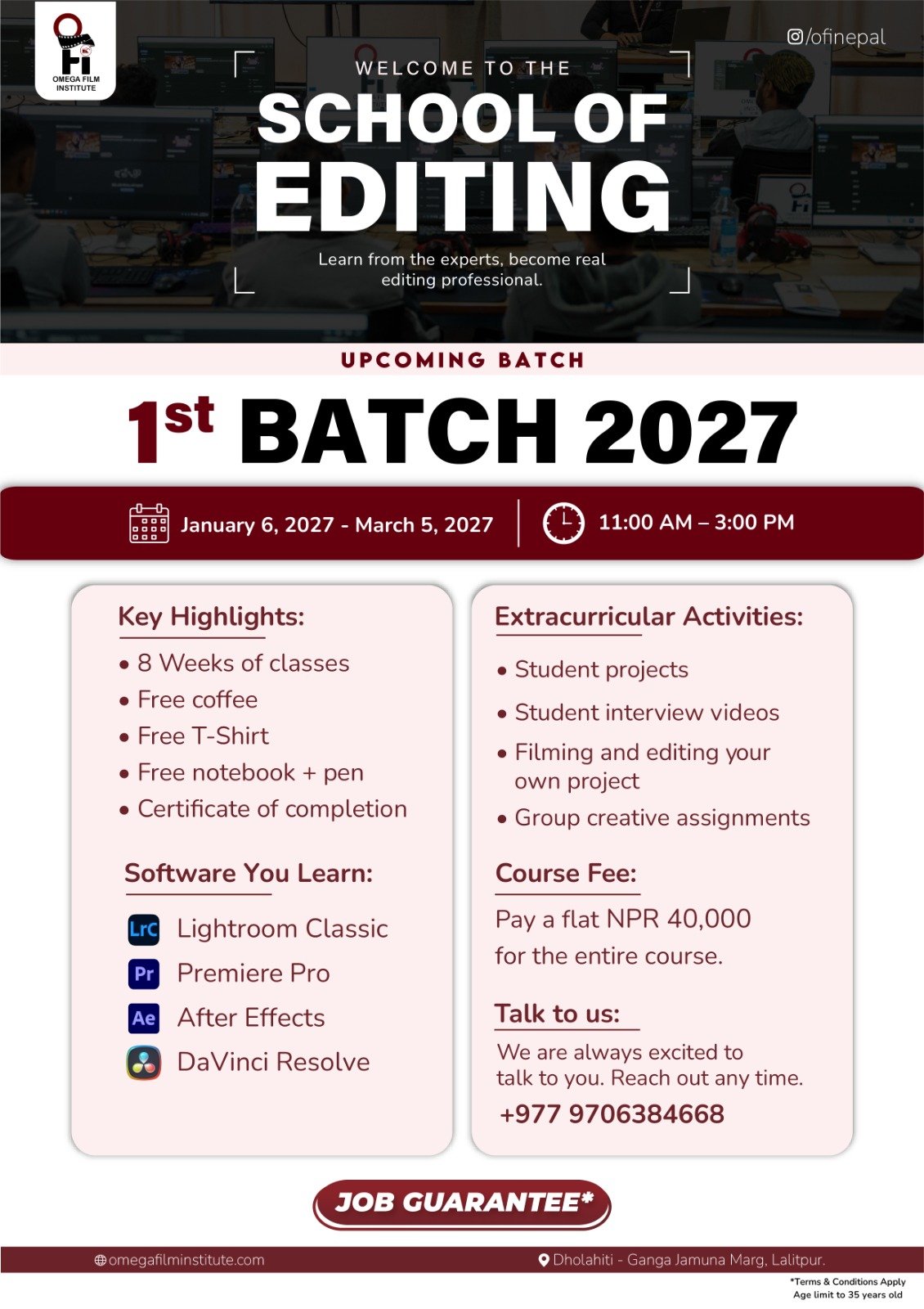
Omega Film Institute (OFI) is a film school in Dholahiti, Lalitpur, focused on the short-course, skills-first route. We teach the crafts that Nepal’s studios, agencies and content teams actually hire for — with small batches, working mentors, and real projects instead of lecture-only theory.
Courses
| Course | Approx. hours | Approx. length | Level |
|---|---|---|---|
| Video Editing | ~65h | ~8 weeks | Beginner-friendly |
| Adobe Premiere Pro | ~55h | ~7 weeks | Beginner-friendly |
| DaVinci Resolve | ~60h | ~8 weeks | Intermediate |
| Colour Grading | ~50h | ~7 weeks | Craft-focused |
| Cinematography | ~75h | ~9 weeks | Beginner-friendly |
| Photography | ~55h | ~7 weeks | Beginner-friendly |
| Motion Graphics (After Effects) | ~55h | ~7 weeks | Beginner-friendly |
Fees (where public): Cinematography from Rs 25,000; Photography from Rs 25,000; Motion Graphics Rs 50,000. Fees for Video Editing, Premiere Pro, DaVinci Resolve and Colour Grading are shared directly on enquiry.
How we teach
- Small batches so every student gets real feedback, not a lecture hall.
- Working mentors who edit, shoot, grade and animate professionally.
- Real projects — you build a portfolio, not just watch demonstrations.
- Part-time friendly — evening and weekend options for students and working people.
- No prerequisites — no prior experience and no own equipment required to start.
- Job support for top graduates — genuine help for our strongest students entering the field. (We don’t guarantee jobs or salaries; anyone who does is not being straight with you.)
The mentor team
OFI’s faculty are practising professionals across editing, colour, cinematography, photography and motion graphics — including senior editors and colourists, and visiting motion-graphics specialists.
Career outcomes: what film skills lead to in Nepal
Film and video skills feed a wide and growing set of roles in Nepal:
- Video editor at production houses, agencies, YouTube and content teams, or freelance.
- Colourist / grading artist for films, ads and music videos.
- Camera operator / cinematographer for events, commercials and film.
- Motion graphics / VFX artist for ads, explainers and title work.
- Photographer across events, product and editorial.
Demand is strongest for video editors, driven by the explosion of digital, social and YouTube content produced in Nepal. Reported monthly pay for video editors in Nepal generally runs from around NPR 15,000-30,000 for freshers, NPR 30,000-60,000 mid-level, and NPR 60,000-120,000+ for experienced editors, with freelancers and those serving international clients often earning outside these bands (sources: Kumari Job, NecoJobs, Glassdoor Nepal). Pay depends heavily on skill, portfolio and location — Kathmandu Valley offers the most opportunities.
These are industry-reported ranges, not OFI figures or promises. Your earnings depend on your work.
Admissions: how to enrol
Getting started at OFI is simple.
- Choose your course from the list above, or call us if you’re unsure which fits your goals.
- Enquire about the current fee, upcoming batch dates and the schedule that suits you.
- Confirm your seat. Batches are small, so seats are limited.
- Start learning — no prior experience or equipment needed.
Visit or contact us:
- Dholahiti, Ganga Jamuna Marg, Lalitpur 44700, Nepal
- Phone: +977 970-6384668
- Email: info@omegafilminstitute.com
- Hours: 10am-5pm (Friday half day to 1pm; Saturday closed)
Frequently asked questions
Is a degree required to work in film or video in Nepal?
No. For editing, colour, motion graphics and camera work, employers and clients care most about your skills and portfolio. A degree helps for some academic and formal roles, but a strong reel from a focused course can get you hired.
Which is better — a BFS degree or a short course?
They serve different goals. A BFS gives a broad, formal degree over several years. A short course builds one employable craft in weeks. Many people start with a short course to enter the field, and some later add a degree.
Do I need my own camera or laptop to start at OFI?
No prior experience or own equipment is required to begin. Ask about what’s provided and what helps to have as you progress.
Can I study while working or studying full-time?
Yes. OFI runs part-time evening and weekend options designed for students and working professionals.
Does OFI guarantee a job?
No honest institute can. OFI provides genuine job support for top graduates, but your outcome depends on your skills and effort.
How much do the courses cost?
Cinematography and Photography start from Rs 25,000, and Motion Graphics is Rs 50,000. Fees for the other courses are shared on enquiry.
Explore next
- Video Editing course
- Cinematography course
- Colour Grading & DaVinci Resolve
- Motion Graphics
- Admissions & contact
Salary figures cited from Kumari Job, NecoJobs and Glassdoor Nepal (2025-2026). Film-education landscape informed by public information on Tribhuvan-University-affiliated BFS colleges and private film academies in the Kathmandu Valley.